This is the final part of the 6-part How STARKs Work series. Be sure to catch up on parts 1-5 of the blog before you read Part 6.
Our prover has computed a huge batch of transactions, registering their steps, verifying their validity, and then “folding” them. Now it’s time to seal the proof and send it to the Verifier.
Hashing it out
The Prover generated a huge sequence of data: the processed transactions and their STARK computation. But where does the Prover register all this information? There’s no sense in committing all of it onchain if the Verifier can verify this data by sampling it. It would be simpler to process 1 million transactions natively to begin with than to run all the elaborate computations and then ask the onchain nodes to process all this excessive data. We also can’t trust the Prover to write it down, because once the Verifier queries samples of entries from the proof, the Prover could change entries to make it look aligned. We need the data sealed before submitting it to the Verifier for inspection.
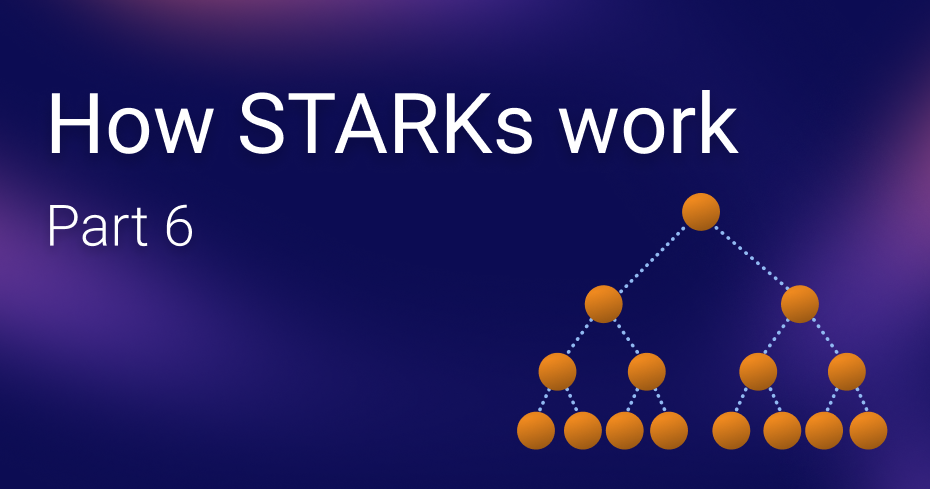
In this phase, we ask the Prover to commit to a sequence of numbers using a cryptographic fingerprinting method called a “Merkle tree”. This technique forces the Prover to commit to a sequence of numbers that cannot be changed later. When reading information from the committed sequence, there’s an efficient cryptographic way to ensure we’re reading the right information, not something the Prover changed after the fact. This is the place, and the only place, where we make a cryptographic assumption – that the hash we use is safe. All the rest is proven by math without any assumptions whatsoever.
Post-quantum security
In a post-quantum world, many cryptographic protocols, including some Zero-Knowledge proofs, could become vulnerable. STARKs have an important advantage: they rely only on hash functions for commitments, and hash functions are post-quantum secure. This makes STARKs inherently post-quantum secure. In contrast, competing proof systems like SNARKs rely heavily on elliptic-curve cryptography, which is vulnerable to quantum attacks. The unique reliance on math rather than complex cryptographic assumptions is what allows STARKs to remain secure against quantum threats.
Final step – verifying the proof and a data commitment
The STARK prover has now generated a STARK proof. The proof attests to the transactions we processed, as well as to their correct processing by the Prover. In the case of an invalid transaction or a malicious processing step, it would be easily detected by the Verifier. The prover also generated a state update, which represents the new state of all accounts involved in the processed transactions. In this phase, the STARK proof and the state update are sent onchain. The onchain Verifier checks the proof, and once it’s verified, the Verifier indicates that the new state update can be accepted onchain.
Summary
To summarize, here is what the STARK protocol achieves:
- A large number of transactions are processed and validated, allowing the chain to be updated with the resulting new state.
- This process relies on the Prover doing the heavy lifting of the computation, leaving the Verifier with the smaller task of checking the STARK proof.
- The Verifier doesn’t re-execute or process the transactions’ data. This means that:
- The process enables scaling, since large amounts of data can be accepted onchain without re-executing transactions
- The process enables privacy, since the Verifier can rely on the STARK proof without accessing the underlying data to confirm validity.
StarkWare has been using STARKs to power blockchains since 2018. While initially focused on achieving massive scaling, the STARK technology is now also being leveraged to provide robust privacy solutions onchain. Additionally, ZK-STARKs can also support post-quantum security requirements. The ability to deliver these capabilities makes STARKs a powerful foundation for the future of blockchain.