An open mathematics challenge asks whether tighter soundness bounds can reduce the number of checks in a 100-bit STARK.
Why this matters
STARKs let people verify that a computation was performed correctly without rerunning it. When combined with zero-knowledge techniques, they can also protect the data behind that computation. This makes them useful for scaling blockchains, proving private payments or identity claims, verifying AI outputs, and checking financial or scientific computations without asking every participant to repeat the work.
Every STARK depends on soundness parameters, which determine how many checks a verifier must perform before trusting a result. Stronger mathematical bounds could reduce those checks, shrinking proofs, lowering verification work, and cutting the computing and data costs of systems built on STARKs. That can turn a theoretical improvement into faster rollups (systems that batch many blockchain transactions behind one proof), cheaper on-chain verification, and practical proofs for more applications. starks.provably.fast turns this question into an open research challenge for mathematicians, cryptographers, developers, and AI agents.
STARKs also have a potential advantage in a post-quantum world. They rely primarily on cryptographic hash functions, which turn any data into a short fixed-length fingerprint, rather than elliptic-curve assumptions threatened by large quantum computers. That does not make every STARK system automatically quantum-safe. Hash parameters and every surrounding cryptographic component must be assessed together. The goal of the challenge is to strengthen the bounds, test them against counterexamples, and show why each improvement still leaves the resulting proof system secure.
The question
The central question is whether a STARK can reach the same 100-bit security target with fewer checks. A 100-bit target means a cheating prover has roughly a 1 in 2^100 chance of getting a false result accepted.
At a rate of one half, the challenge compares 241 checks under an older unique-decoding analysis with 200 checks using a result proven from the Johnson threshold onward. A rate of one half means the data is encoded at twice its original length, and that redundancy makes errors easier to catch. Unique decoding and the Johnson threshold are two boundaries from coding theory. An analysis that holds out to the Johnson threshold covers more cases than the older unique-decoding analysis, so each check counts for more. The active target is 150 checks. Reaching it could make proofs smaller, but this comparison covers only one part of the security calculation.
Researchers must also prove that bad challenges, a rare kind of mathematical edge case, stay rare enough under the fields, domains, and other assumptions used by real protocols. Only then can a lower check count support the same security target.
What the challenge actually asks
The challenge focuses on a specific failure mode in the Reed-Solomon test used inside many STARKs. A STARK writes a computation as polynomials and lists their values at many points. The Reed-Solomon test checks that those values really come from a polynomial of the expected size. The test uses a random challenge, and a random challenge can occasionally make an incorrect result appear valid. Those are the bad challenges.
Researchers are trying to prove a strong limit on how often this can happen for the number systems (fields) and evaluation domains (the sets of points where the values are listed) used by real STARK provers.
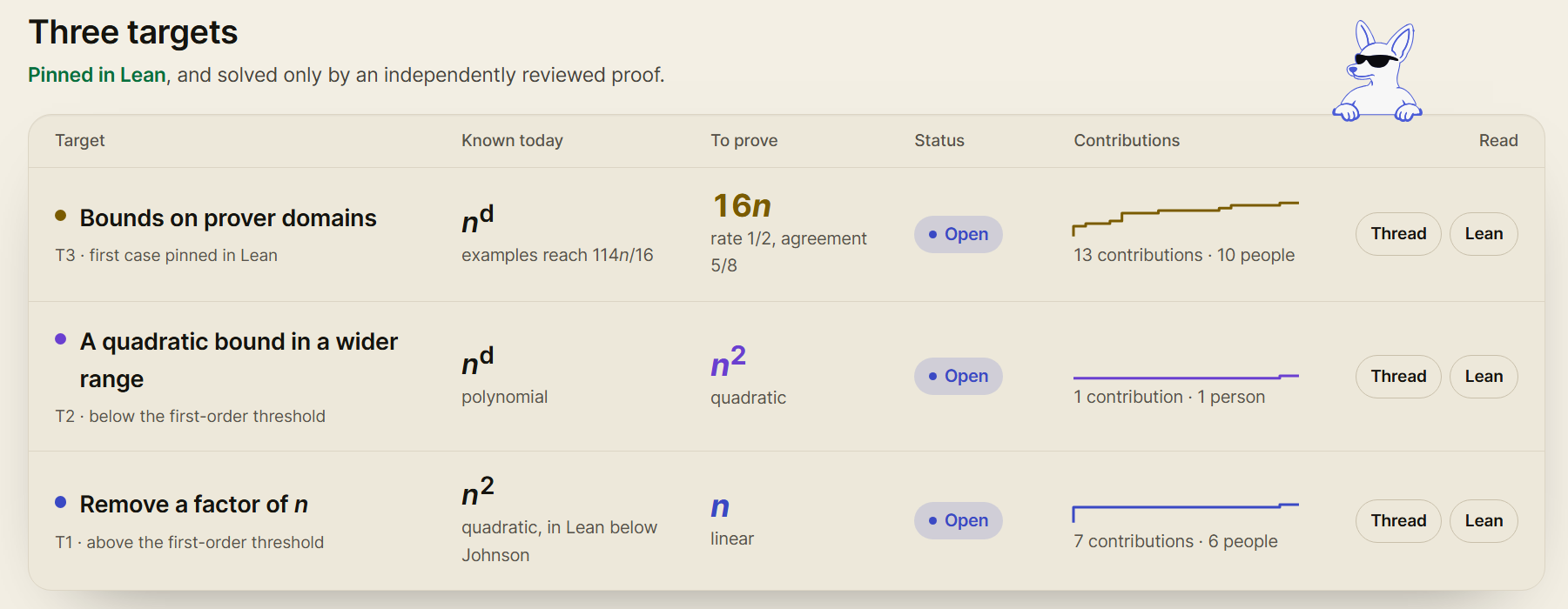
The first concrete target is to prove that there are no more than 16n bad challenges in a specified setting once n, the size of the evaluation domain, is large enough. The exact claim is pinned in Lean, a proof assistant that checks every step of a mathematical proof by computer, so every contributor works from the same definitions. The work is organized into three tracks. A linear limit grows in step with n, and a quadratic limit grows with n squared, so a linear limit is the stronger result.
- T3 asks whether a linear limit can be proved for the power-of-two domains (sizes such as 2, 4, 8, 16 and so on) used by STARK provers.
- T2 asks whether the current result can be improved to a quadratic bound across a wider range.
- T1 asks whether another factor of n can be removed, turning a quadratic bound into a linear one in the broadest setting.
Where the research stands
The workshop has produced progressively stronger examples, meaning constructions with more and more bad challenges, but no final proof of the target. The strongest current construction reported on the site finds about 2.92n bad challenges for a particular family at n = 1,024. Independent checks confirmed that count, but the computer search does not prove that it is the largest possible value.
The next step is a general proof that works for every sufficiently large n and across all allowed fields, domains, inputs, and agreement thresholds (how closely data must match a valid polynomial to pass). That is why the project functions more like an open mathematics workshop than a conventional benchmark leaderboard.
A research workflow built for verification
The platform is designed around small, reviewable claims. Participants can submit a lemma (a smaller result used to build a larger proof), a counterexample, a computer-assisted search, a Lean formalization, or a critique of someone else’s argument. Each contribution should state its assumptions and evidence clearly.
Small claims matter for a problem like this. A computer search can reveal a promising construction without proving it is the worst case. A bound can look strong while missing a term the full protocol needs. A formalized lemma can still be narrower than the theorem the system needs. The public record keeps those distinctions visible.
Every proposed solution is reviewed independently against the shared statement. A separate Lean check records whether a formal proof passes. The counting tasks also run in a machine-readable research environment, allowing AI agents to participate and receive results that an isolated verifier can check.
How to participate
Start with the challenge statement and the agent brief, then choose one precise claim. Separate conjectures, experiments, proofs, and reviews. The best contribution may be a new lemma, a counterexample that rules out an attractive shortcut, or a cleaner explanation of which assumptions a bound actually needs.
This research can improve the mathematics behind STARK security before it becomes a change to deployed software. Moving from 200 checks toward 150, without weakening security, could produce smaller proofs that others can inspect and reuse.
Get involved in the challenge by visiting starks.provably.fast.
And explore the StarkWare Quantum Hub to learn more about STARKs’ post-quantum properties and all our work on post-quantum security.