


Identity verification online still works the way it did a decade ago: to prove a single fact about yourself – that you’re over 18, or that you hold a valid credential – you hand over your whole document. Name, date of birth, nationality, and document number all get copied to a verifier who stores them, reuses them, and becomes a liability the moment they’re breached. Every check leaves another copy of your identity sitting in another database.
Private KYC is a demonstration of ZK-identity built on STRK20, Starknet’s privacy capability for ERC-20 assets. It moves verification onto a path where the holder encrypts their identity to their own public Starknet account and discloses only a proof of the specific attribute being checked – never the underlying document.
It’s a concrete reference for how government and institutional onboarding can work when proving an attribute no longer means surrendering the data behind it.
The STRK20 Value Proposition
Private KYC showcases STRK20’s selective-disclosure and programmable-eligibility capabilities applied to identity, letting institutions verify the facts they need without taking custody of the data behind them.
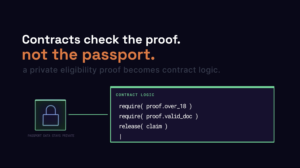
- Programmable eligibility, not a static badge: A verified attribute becomes an onchain signal a contract can act on – the demo gates a shielded private claim from a payout pool to identified accounts only. Identity and value sit on one Starknet privacy layer, and other contracts can check that same eligibility signal – without the identity behind it ever being exposed.
- Self-custodied identity: The holder encrypts their identity directly to their own public Starknet account – they hold it; no central verifier collects or warehouses the raw document. The encrypted identity has no viewing key and is never decryptable; only the attributes the holder proves are revealed.
- Selective disclosure, no verifier honeypot: Prove a specific attribute – such as being over 18 – without revealing name, date of birth, or document number. Institutions confirm it by reading a public onchain registry and gating actions to verified accounts, without ever scanning, storing, or becoming a liability for personal identity data.
The User Flow
Private KYC follows a single holder, from scanning a document to receiving a gated private transfer – without the underlying identity ever leaving their control.
1. Self-Service Passport Scan
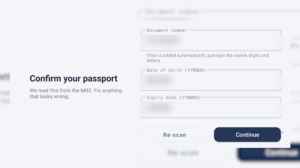
The user opens the app on their own phone and scans their passport using the camera and NFC chip read. The chip read confirms the document is genuine – signed by its issuing authority – without anyone else handling it. Onboarding is self-service; there is no verification desk collecting documents.
2. Encrypted Registration
The user connects their wallet, and the app encrypts their identity to their own public Starknet account, registering attributes such as over-18 to a public onchain registry. Each passport can register only once, binding one verified identity to one account.
3. Proof Generation & Onchain Submission
The app generates a zero-knowledge proof of the registered attributes and submits it onchain. From there, the attribute can be checked by whoever needs it – while the name, date of birth, and document number behind it stay encrypted.
4. Gated Private Transfer
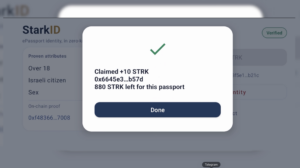
A verifier reads the onchain registry to confirm an account is identified, and the demo gates a shielded private claim from a payout pool to identified accounts only. Verification and the action it unlocks happen without the verifier ever seeing the identity behind the account.
The Possibilities for Onchain Identity
Private KYC shows that verification and privacy aren’t a trade-off. An institution can confirm exactly what it needs – that someone is over 18, holds a valid credential, or meets an eligibility rule – without assembling another copy of someone’s identity it then has to defend. Selective disclosure turns identity from a liability that accumulates into a proof that travels.
Private KYC is a working demonstration we use to walk government and institutional teams through ZK-identity on Starknet. If your organization verifies identity – or is exploring how to do it without holding the data behind it – we’d like to talk. Contact us to see the full flow.


