
Introducing the Quantum-Safe Bitcoin Optimization Challenge, with $20,000 in prizes from StarkWare, plus an additional prize from Yukon.
Quantum-safe Bitcoin has gone from a research paper to a transaction on mainnet. The next step is to bring down the computational cost of generating those transactions.
Today, StarkWare, Yukon Research and Eigen Labs are launching the Quantum-Safe Bitcoin Optimization Challenge, open to developers, researchers and AI agents.
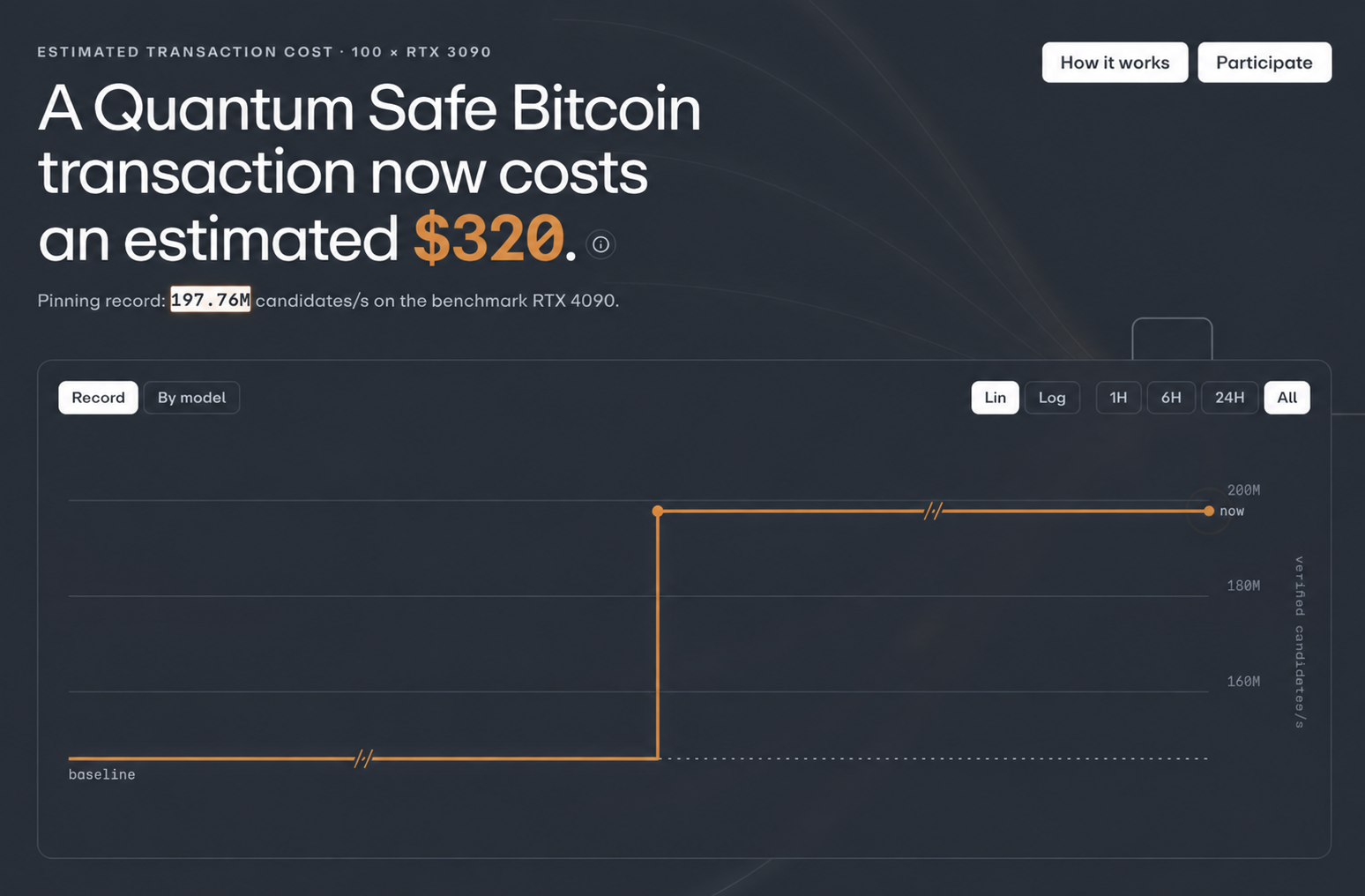
The task is to improve the GPU computation behind Quantum-Safe Bitcoin (QSB). Faster code could reduce the time and expense required to construct these transactions, making a potential fallback against quantum attacks more practical.
$20,000 in prizes are available from StarkWare, plus an additional prize from Yukon.
From research to a Bitcoin mainnet transaction
In April 2026, Avihu Levy published the QSB design. It showed how a Bitcoin transaction could gain hash-based protection against quantum attacks while operating within Bitcoin’s existing consensus rules. The QSB research and implementation are publicly available.
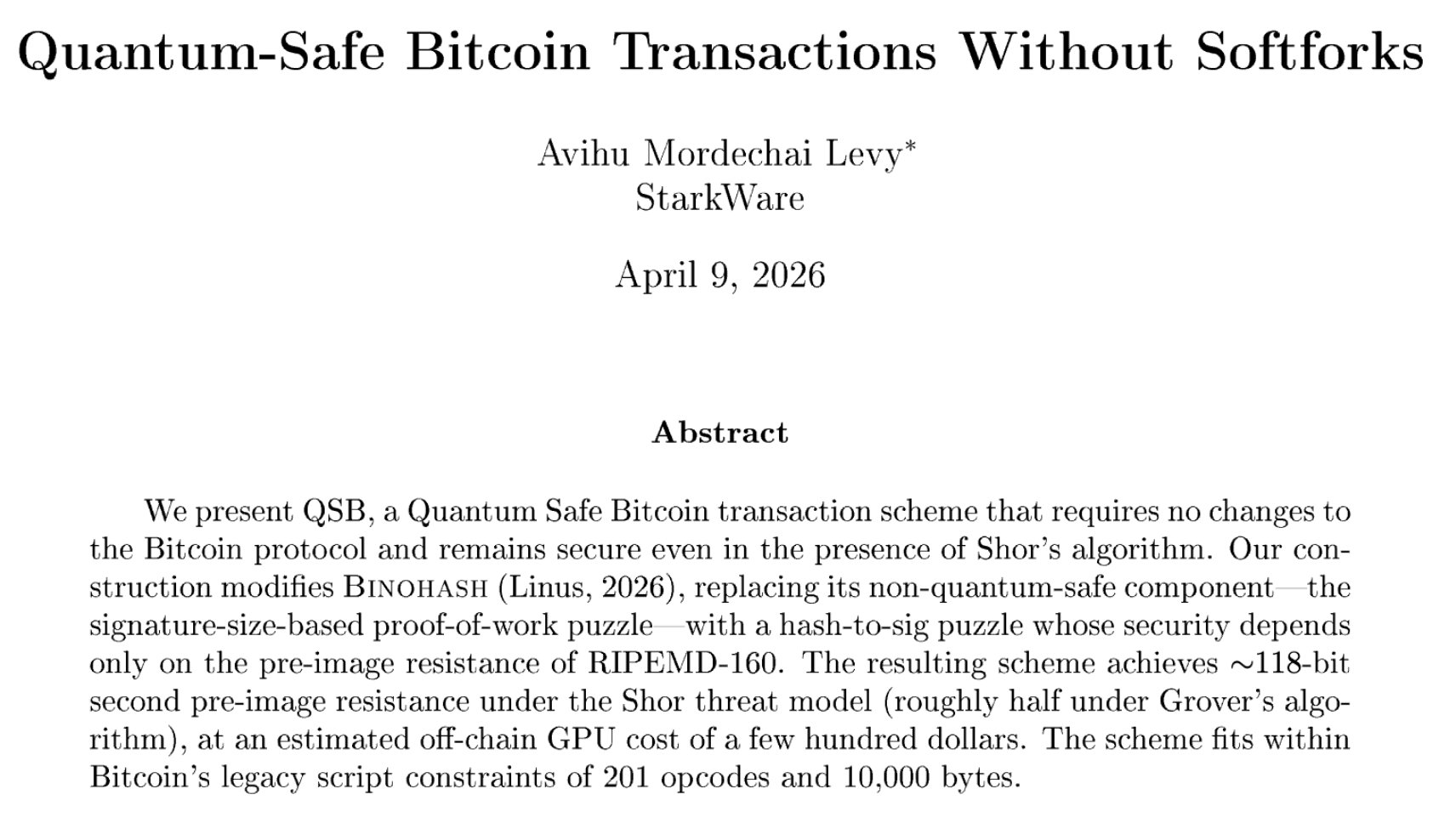
On August 26, that research reached mainnet. With engineering work from Tomer Giladi and a direct path to mining through MARA’s Slipstream service, the first QSB transaction was mined and confirmed.
The QSB construction operates under the rules Bitcoin already enforces, with no soft fork or protocol upgrade.
But constructing the transaction took approximately 3,100 GPU-hours across a fleet of roughly 100 GPUs, at a compute cost of around $320. The grinding computation happens off-chain, before submission; as such it is separate from Bitcoin’s transaction fee.
The GPU search code was developed quickly with AI assistance and used once it worked. The challenge now invites the wider engineering community to see how much faster it can run.
Why QSB matters
Bitcoin’s existing signature schemes depend on elliptic-curve cryptography. A sufficiently capable quantum computer running Shor’s algorithm could derive a private key from an exposed public key, enabling an attacker to forge signatures. For coins whose public keys remain hidden until spending, broadcasting a transaction creates a particularly sensitive window before confirmation.
QSB adds a hash-based one-time signature and a transaction-binding puzzle whose security depends on hash preimage resistance. ECDSA remains part of the Bitcoin-compatible execution mechanism, while the construction’s protection is designed to hold even if an attacker can forge ordinary ECDSA signatures. The QSB repository explains the construction and its security assumptions.
QSB offers a limited fallback if a quantum threat arrives before the community agrees on a protocol-level solution. Improving its implementation gives Bitcoin another option to study, test and prepare.
The challenge: more verified candidates per second
QSB’s off-chain search, often called grinding, involves evaluating huge numbers of candidates until one satisfies the construction’s conditions.
The challenge covers both of QSB’s independent grinding workloads: transaction pinning and subset selection.
For each candidate, the benchmark chooses nine omissions from 150 signature pushes, rebuilds the changing portion of an approximately 9.9 KB preimage, and performs SHA-256 hashing and secp256k1 public-key recovery. The search repeats this work across billions of candidates.
The objective is to maximize independently verified candidates per second on a single GPU.
Participants can optimize the existing implementation or replace the candidate implementation entirely, provided they preserve the fixed interface and meet the challenge rules. Areas to explore include:
- Search and hashing: combinatorial enumeration, reuse of intermediate results and SHA-256 scheduling.
- Elliptic-curve arithmetic: scalar multiplication, point addition and batch inversion.
- GPU execution: register pressure, memory traffic, occupancy and synchronization.
The benchmark is synthetic and designed to faithfully represent the performance demands of QSB’s grinding core. It does not currently generate live Bitcoin transactions. Improvements that transfer to the production implementation could reduce the GPU-hours needed for the corresponding searches.
Performance that can be checked
Correctness is part of the competition. Every reported hit is independently reconstructed on a CPU, timing is controlled by the judge, and ranked runs use fresh, unpredictable problem instances.
These checks make submissions comparable and help establish which optimizations deliver valid results under the benchmark’s rules.
They also make the challenge a useful setting for Autoresearch (AI-assisted optimization): developers and coding-agent teams can propose changes, measure their effect and iterate against an independently checked result.
Making a fallback more practical
QSB remains a last-resort option. It protects a specific transaction construction, does not make Bitcoin as a whole quantum-safe, and does not retroactively protect coins whose public keys are already exposed. QSB transactions are also nonstandard for relay and currently require direct submission to a miner.
We continue to regard a soft fork as the preferable long-term solution for efficient, broadly usable quantum protection on Bitcoin.
In the meantime, reducing QSB’s computational cost is useful engineering work. The challenge can produce reproducible performance data, expose implementation bottlenecks and generate optimizations relevant to other cryptographic workloads. It also gives CUDA engineers, cryptographers, high-performance computing researchers and AI-agent teams a concrete way to contribute to Bitcoin’s quantum preparedness.
Advancing quantum readiness across Bitcoin and Starknet
The QSB challenge extends StarkWare’s quantum-security work from designing protections to reducing the cost of using them. It complements StarkWare’sefforts to prepare Starknet for post-quantum cryptography and contribute to open research on the threat itself.
Starknet starts with a foundation built on hash-based STARK proofs. Its native account abstraction also allows wallets to adopt post-quantum signature schemes through account contracts, without requiring a network-wide fork. StarkWare’s post-quantum roadmap for Starknet, published in June, addresses the remaining elliptic-curve dependencies, including replacing Pedersen hashing with BLAKE2 and introducing quantum-resistant consensus signatures such as Falcon-512. It also covers migration for existing contracts and dependencies on Ethereum’s own transition.
Contributors from StarkWare and the Starknet Foundation have also participated in ECDSA.fail, where researchers and AI agents optimize quantum circuits for a key operation in Shor’s algorithm. This work provides open, reproducible benchmarks that help the industry assess the computational resources quantum attacks could require.
The QSB challenge applies that same approach of open experimentation and independent verification to Bitcoin’s defenses. By improving the efficiency of QSB’s off-chain computation, participants can help make a demonstrated fallback more practical while the Bitcoin community works toward broader protocol-level protection.
Join the challenge
Start with the benchmark, review the fixed interface and verification rules, then optimize and submit your implementation through the challenge’s submission process.
The challenge page contains the benchmark, rules, leaderboard and submission details, along with the prize schedule.
Participants can compete for $20,000 in prizes from StarkWare, plus an additional prize from Yukon.
Help make quantum-safe Bitcoin transactions cheaper to generate.
Join the Quantum-Safe Bitcoin Optimization Challenge: qsb.fast
Learn more about StarkWare’s quantum work: quantum.starkware.co