

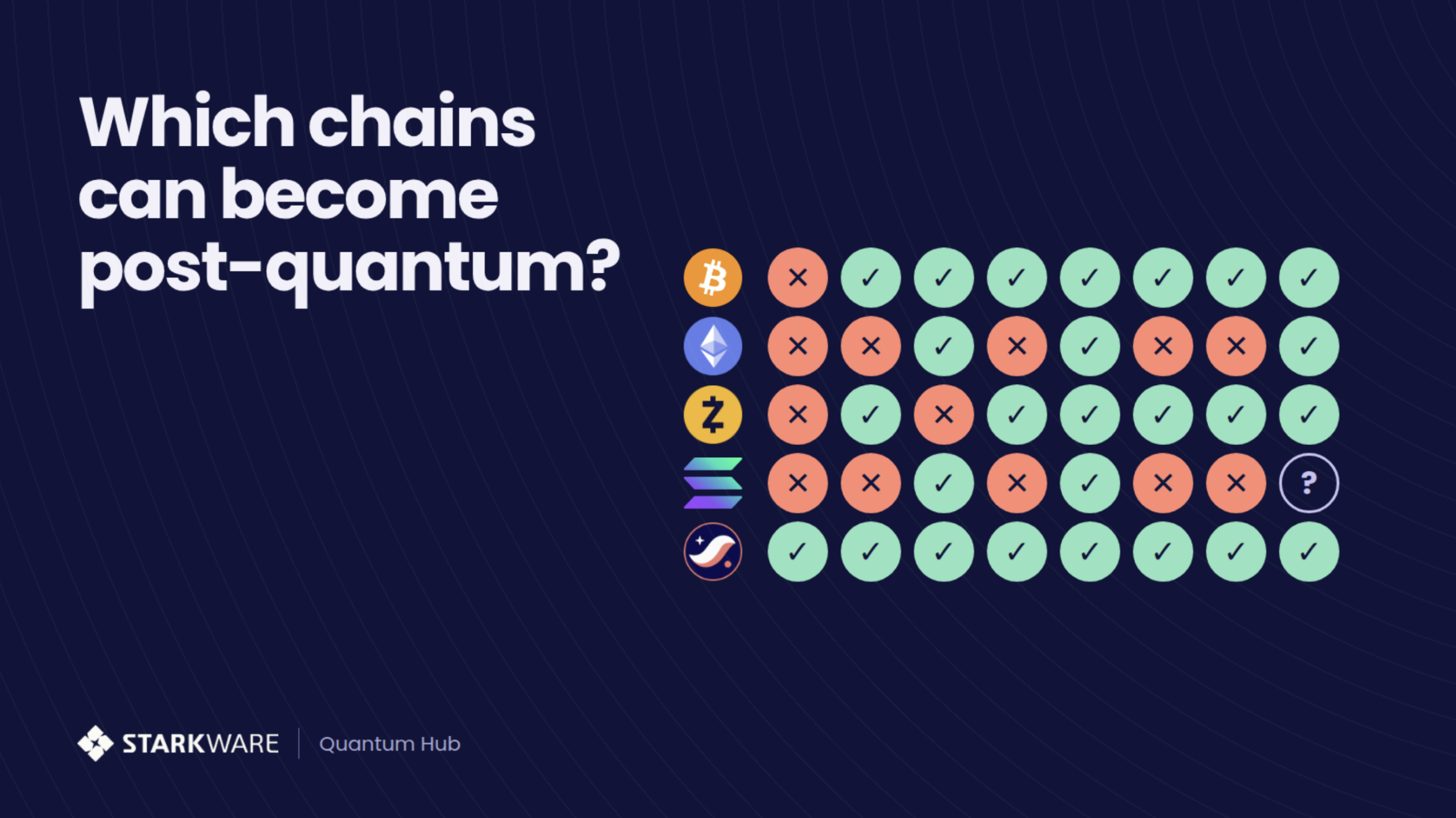
An analysis of Starknet, Bitcoin, Ethereum, Zcash, and Solana
Status claims are as of StarkWare Quantum Hub reviews in late September and early October 2026.
AI is speeding up the research behind a quantum attack on blockchain signatures. Since late May, dozens of participants working with AI coding agents in ECDSA.fail, an open challenge run by Eigen Labs, have cut the estimated quantum resources for a key step in breaking Bitcoin and Ethereum signatures by about 91%.
A blockchain that needs to protect its users from quantum computers has to replace the cryptography those users sign with. Most networks can’t yet do that for their standard accounts without a network upgrade, and some leading proposals would require every holder to act before a deadline.
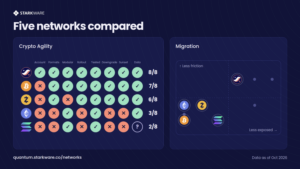
To make that visible, StarkWare, a core developer of Starknet, built two tools on the Quantum Hub Networks page: a crypto agility table and a migration map. The table asks whether a network can change its cryptography and keep running. The map asks how much is still exposed to quantum attack and what migrating would ask of the people holding funds. This post explains both, then assesses the positions of five networks: Starknet, Bitcoin, Ethereum, Zcash and Solana.

What does a quantum computer threaten in a blockchain?
A large enough quantum computer threatens the digital signatures that prove who owns what. Most blockchains use elliptic-curve signatures. Each account has a private key, which signs, and a public key, which anyone can see and use to check a signature.
Working out a private key from its public key would take today’s computers far too long to be practical. The math behind elliptic-curve signatures is designed to be that hard. Shor’s algorithm for quantum computers solves this problem exponentially faster than any known method on ordinary computers. A large enough quantum computer running Shor’s algorithm could recover a private key from its public key. Anyone holding that key could sign transactions as the owner and move the funds.
Public keys are often visible. Some address types put the public key onchain permanently. In Bitcoin, many outputs reveal a public key when spent. Taproot and early pay-to-public-key outputs expose one when created. Funds behind a visible public key would be among the first a quantum attacker could reach.
Nobody can say when such a machine will exist. That day is often called Q-Day. This comparison doesn’t predict a date. It measures what networks can do in the meantime.
Replacement schemes already exist. NIST published two post-quantum signature standards in 2024: ML-DSA (FIPS 204) and SLH-DSA (FIPS 205). Cryptography built on hash functions is not broken by Shor’s algorithm, which is why hash-based designs come up repeatedly in this post. The hard part for a blockchain is moving millions of existing accounts onto post-quantum signatures.
What is crypto agility?
Cryptographic agility is a system’s ability to replace its cryptographic algorithms while it continues to operate securely. The definition comes from NIST’s guidance on the subject, published as CSWP 39 (updated June 2026). A network with high crypto agility can add a new signature scheme, run it alongside the old one, move users over, and retire the old one. A network with low crypto agility needs a coordinated overhaul to do any of that.
Agility matters before a quantum threat arrives. A network that can only change cryptography through a large coordinated upgrade has to start that work earlier and needs more people to agree.
How does the crypto agility table work?

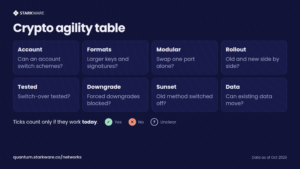
The table asks 8 yes-or-no questions of each network, informed by NIST’s guidance on crypto agility. For example, they ask whether an existing account can change its signature scheme, and whether old and new signing can run side by side while users move. Each “yes” backed by evidence earns one point.
To earn that point, the path has to work today under current network rules. A capability that needs a future upgrade earns nothing. One enabled by a past upgrade still counts if people can still use it. We fixed these rules before scoring, and every cell on the Hub can be opened to show its evidence and public sources.
The total counts capabilities and makes no claim about a network’s overall security. A point doesn’t necessarily mean the network has used the capability.
How does the migration map work?

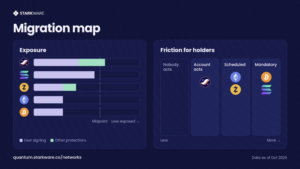
The map places each network on two scales. Exposure measures how far a network has moved user signing toward post-quantum cryptography. The scale runs from research announced up to post-quantum signing built into the network itself. Networks also get credit for protections outside signing, such as a layer that already relies on hash-based cryptography.
Friction measures what migration would require of the people holding funds. At the low end, owners don’t need to do anything. At the high end, holders who don’t act face a stated consequence, such as frozen funds or keys that can no longer be signed. A network with no published migration mechanism gets no friction tier, because there’s nothing yet to score.
The map leaves out bridges, external dependencies, adoption, and the signatures validators use to agree on blocks. A low-exposure placement shows progress in user signing and related protections. It doesn’t certify a network as quantum-resistant.
Why can a network score well on one test and poorly on the other?
The two tools measure different things. The table measures whether the machinery for changing cryptography exists. The map measures how much still needs to change and how much of that work falls on holders.
Bitcoin shows the gap most clearly. It passes 7 of 8 crypto agility checks, yet sits in the highest friction tier, because its leading migration proposal sets deadlines that holders must meet. A working upgrade mechanism doesn’t move anyone’s coins.
Starknet

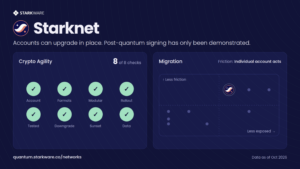
Crypto agility: 8 of 8. The clearest example is account change. Starknet has native account abstraction, which means every account is a smart contract. The protocol allows a contract to replace its code while keeping its address and storage, so any wallet can switch how it checks signatures in place if its account code allows it. We confirmed this using the Ready (formerly Argent) account, a mainstream Starknet wallet. It can replace its signature-checking code through an authenticated upgrade and keep its address and funds. Other wallets’ accounts may handle upgrades differently. Any upgrade must also follow the supported version sequence, because unsupported paths can lock an account.
The upgrade we checked adds a classical signer, not a post-quantum one. It shows the mechanism works. The Falcon-512 account described below is a separate demonstration.
Map: lower exposure, lower friction. Two facts drive the exposure placement:
- Account signing is only demonstrated. An OpenZeppelin account using Falcon-512, a post-quantum signature scheme, has been demonstrated on Starknet mainnet. Its implementations are unaudited, and an ordinary user can’t adopt it yet. StarkWare has also signed a Starknet testnet transaction with an ML-DSA key held in a phone’s secure chip. The signature check fits within Starknet’s per-transaction cost limit. That proof of concept is also unaudited. Standard Starknet accounts still sign with elliptic-curve cryptography.
- Structural credit for the proof system. StarkWare’s STARK proofs verify Starknet’s state transitions, and those proofs rely on hash functions instead of elliptic curves.
Starknet sits just past the map’s midpoint, and only because of structural credit. On user signing alone, Solana is ahead: any Solana user can adopt a post-quantum vault today, while Starknet’s post-quantum account is still a demonstration. The credit reflects StarkWare’s hash-based proof system, which protects the network’s state but not individual accounts. Networks with post-quantum signing built into the protocol sit further along.
Friction tier: individual account acts. An account owner can deploy or upgrade to a post-quantum account alone, without waiting for a network-wide migration.
What has shipped and what remains.
- Shipped: Starknet v0.14.3 replaced the Pedersen hash with a BLAKE2s-256 construction for operating-system program and configuration hashes on mainnet.
- Roadmap direction: changes to the state trie and contract addresses.
- Research: tooling for existing contracts whose storage relies on Pedersen hashes.
- Under consideration: On 8 October 2026, StarkWare said it is actively considering making Starknet an independent layer 1 (L1). As an L1, it could make its own post-quantum security upgrades without waiting for Ethereum. No formal decision or plan has been published yet.
- Outside Starknet’s control, for now: Starknet currently publishes its state data to Ethereum as blobs, which depend on Ethereum’s KZG commitment scheme. Starknet can’t migrate that scheme on its own; posting the data as calldata is an available fallback. Becoming an L1 would remove this dependency, but Starknet would then need its own validators and data availability.
Bitcoin
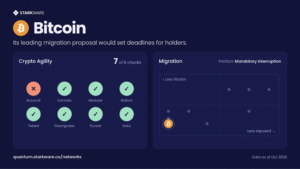

Crypto agility: 7 of 8. Bitcoin has changed its signature cryptography before. The Taproot upgrade added Schnorr signatures alongside ECDSA, and standard wallets support both.
The one miss is account change. A Bitcoin coin can’t switch to a new signature scheme where it sits. To use new cryptography, it has to be sent to a new address. A new native signature type would first need new consensus rules.
Map: higher exposure, higher friction. A Quantum-Safe Bitcoin (QSB) transaction was mined on mainnet in August 2026. It used a nonstandard format and went directly to a miner. Bitcoin still has no native post-quantum signature type for ordinary wallets. Two draft proposals set the direction:
- BIP-360 would add an output type that protects keys from long-exposure attacks. Its authors note that defending against faster attacks would need post-quantum signatures in a separate proposal.
- BIP-361 sets deadlines. As drafted, about three years after activation, coins could no longer be sent to quantum-vulnerable address types. Two years after that, old-style signatures alone would no longer be enough to spend. Owners would need to pass a rescue check, such as proving they know the parent key their address was derived from. Coins that can’t pass it would stay locked. The draft depends on a post-quantum signature proposal that hasn’t been written, and it has no consensus.
Because BIP-361 attaches a consequence to not moving, the map scores Bitcoin’s migration as a mandatory interruption.
What makes it hard. Some coins already show their public keys onchain. These include the earliest pay-to-public-key coins, coins at reused addresses and Taproot coins. Owners who have lost their keys cannot move those coins. Ledger estimates that 3 to 4 million bitcoin are already lost or inaccessible, though the exact figure is hard to pin down. Bitcoin’s ability to add new signature types doesn’t solve either problem. Exposed coins remain at risk until their owners move them. If a lost coin’s public key is exposed and its signature type remains valid, a capable quantum attacker could spend it. Bitcoin’s community still has to decide what should happen to exposed coins nobody moves.
Ethereum

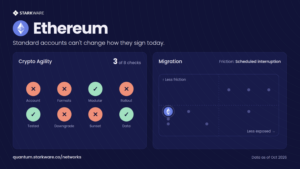
Crypto agility: 3 of 8. Ethereum passes on modular updates, tested transition and existing data. The existing data example is a mechanism that lets validators convert old BLS withdrawal credentials into an Ethereum address under current rules. It shows stored data can migrate. It isn’t itself a quantum step, because the destination address still uses elliptic-curve signatures.
Several misses trace to one design fact. The standard Ethereum account, the kind most wallets create, signs with secp256k1 ECDSA and can’t change that in place.
Smart-contract accounts under ERC-4337 can run custom signature checks, including a post-quantum verifier. They are optional, and the table scores the standard account. EIP-7702 delegation alone doesn’t remove the original key’s power to sign.
Map: higher exposure, higher friction. No post-quantum user signing runs on Ethereum mainnet. Ethereum’s roadmap covers three things:
- Four parts named. In February 2026, Vitalik Buterin identified four areas that rely on quantum-vulnerable cryptography: consensus-layer BLS signatures, KZG commitments for data availability, ECDSA signatures on standard accounts, and the zero-knowledge proof systems used by applications and layer-2 networks.
- A dedicated team. The Ethereum Foundation set up a dedicated post-quantum security team in January 2026.
- A target date. The roadmap targets around 2029 for core infrastructure.
The published path is planned network upgrades followed by account owners acting under EIP-8141. That draft proposal is designed to give accounts a native route from the elliptic-curve cryptography Ethereum uses today to post-quantum systems. No hard cutoff is stated, so the map scores this as a scheduled interruption.
What happens to dormant wallets is still undecided.
Zcash

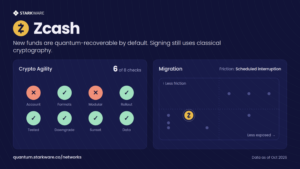
Crypto agility: 6 of 8. Zcash handles new key and signature formats, runs old and new pools side by side, and moves existing funds.
The two misses are account change and modular updates. An existing address can’t take a new signature check in place. Replacing the proof system still needs a coordinated network upgrade. NU6.3 added Ironwood but reused Orchard’s Halo 2 proof system, so it did not meet the checklist’s test for replacing proofs without another upgrade.
Map: higher exposure, higher friction. NU6.3 activated the Ironwood pool on 28 July 2026 at block 3,428,143. Every new Ironwood note is quantum-recoverable by default. Each note is built so that a future recovery protocol can confirm it is genuine and rescue the funds if today’s elliptic-curve cryptography ever has to be switched off. The older Orchard pool can now only be spent from, not added to, and wallets have a supported route to move funds into Ironwood.
That earns Zcash structural credit as a shipped, default-on mitigation. Exposure stays on the higher side because Zcash’s signatures, proofs and note encryption still rely on quantum-vulnerable cryptography. Zcash’s own documentation says recoverable notes are not a post-quantum protocol by themselves.
Friction tier: scheduled interruption. A coordinated upgrade comes first, then users move funds out of Orchard. Our review considered a harsher score, because a spend-only pool resembles a cutoff. It kept the scheduled tier because Orchard funds remain spendable and no deadline is stated.
Solana

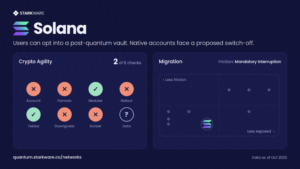
Crypto Agility: 2 of 8. Solana passes on modular updates and tested transition. For modular updates, validators can run the Frankendancer client, which uses its own implementation of the network’s transport encryption without changing consensus rules.
Solana’s native accounts are tied to Ed25519 signatures, with no in-place change or side-by-side route. One cell is marked not established. A tool exists to convert old nonce accounts, but a limited check found no eligible old accounts to convert, so a working migration of existing data wasn’t established.
Map: higher exposure, higher friction. Solana’s exposure score reflects Blueshift’s Winternitz Vault, which any user has been able to adopt for over two years. It protects funds with hash-based one-time signatures at the application layer, and native Solana accounts don’t use it.
The vault holds only SOL, Solana’s native coin, and supports three actions: opening a vault, sending part of its balance, and closing it. It can’t hold other tokens, and funds inside it can’t be staked or used in apps. Each Winternitz key can sign only once, so every spend closes the vault and moves any remaining balance to a new one.
Friction is scored on native accounts. The Solana Foundation’s roadmap says that if quantum computing becomes a credible threat, Solana would adopt a post-quantum scheme for new wallets and then migrate existing ones. Research from the Firedancer team proposes the mechanism:
- Switch off Ed25519 signature verification.
- Let owners move funds by presenting a new post-quantum signature and a zero-knowledge proof that they hold the original wallet seed.
Switching off the old scheme attaches a consequence to not moving, so the map scores this proposed path as a mandatory interruption. The vault only protects SOL that users choose to move into it. For everything held in standard Solana accounts, protection depends on the proposed native migration.
What should holders and institutions ask about a network?
The table and map turn into four practical questions for anyone holding assets on a blockchain:
- Is the public key behind my funds visible onchain? If it is, those funds would be among the first a quantum attacker could reach. Address reuse, older address types and some newer ones, such as Bitcoin’s Taproot, all expose public keys.
- Does the network have a published migration mechanism, and what does it require of me? The friction tiers show whether you would act alone, wait for a coordinated upgrade, or face a deadline.
- Is there a deadline, and what happens if I miss it? Proposals with mandatory interruptions attach consequences to inaction, such as locked funds or a recovery process with extra steps.
- What can’t the network migrate by itself? Dependencies on other chains, bridges and external systems sit outside the map and need checking separately.
The tools don’t say when to act. They show what each network can do today and what it would ask of holders later.
Learn more about the full table, map and sources by visiting the Networks page of StarkWare’s Quantum Hub.
If you believe the scoring or evidence requires a change, email james.w@starkware.co with the network, the table criterion or map placement, your suggested change and links to supporting evidence.