

Main Takeaways
- AI is making quantum attacks cheaper, and could weaken post-quantum standards like ML-DSA on ordinary computers.
- “Quantum-resistant” is a moving target. What lasts is cryptographic agility.
- Starknet is built for it: hash-based proofs, accounts that can change their cryptography, and a path to full control as an L1.
For decades, the quantum question was when a quantum computer may arrive. In 2026 a second question took over: how fast is the math moving? AI is now helping find cheaper attacks and new proofs at a pace human research alone has not matched. That shortens the road to Q-Day, the day a quantum computer can break today’s cryptography.
It also raises a new risk: some cryptography may fall to better math on ordinary computers, with no quantum computer involved.
How is AI speeding up attacks on cryptography?
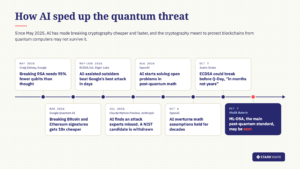
AI is making attacks on cryptography faster and cheaper to find, every few months. Here is how the last year unfolded.
The baseline. In May 2025, Google researcher Craig Gidney estimated that a quantum computer with fewer than one million noisy qubits could break RSA-2048 in under a week (arXiv). The previous estimate was 20 million, over a 95% decrease.
Google cuts the cost of breaking blockchain signatures. In March 2026, Google Quantum AI published a new estimate for attacking the elliptic curve behind Bitcoin and Ethereum signatures. It was roughly ten times cheaper than the best previous estimate: about 1,200 to 1,450 logical qubits. Google judged the details too dangerous to publish. It withheld its circuits and released a zero-knowledge proof that they exist.
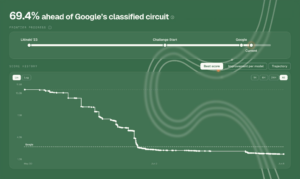
AI-powered open challenge beats Google. At the end of May, ecdsa.fail turned Google’s work into an open challenge, where anyone could submit their own circuits and score against Google’s work. More than 100 people entered, most working with AI. They surpassed Google’s figure in under three days. Google’s figure came from one of the world’s top quantum research teams. AI powered collaborative open work by regular people sits 69.4% ahead of Google’s number.
AI finds an attack NIST’s experts missed. In July 2026, Anthropic’s Claude Mythos Preview found a new attack on HAWK. HAWK had spent three years in NIST’s search for backup signature standards, surviving two rounds of cuts from a field of 40, and was the only lattice-based scheme to reach the final rounds. Years of expert review had missed the attack. HAWK was withdrawn the next day (Anthropic).
AI starts doing new mathematics. In August, OpenAI said an internal model had solved 10 open problems, including new results on the lattice based mathematics that post-quantum cryptography is built on (The Quantum Insider). In October, OpenAI released 722 math papers written by AI. Many disproved assumptions mathematicians had relied on for decades (OpenAI, SiliconANGLE).
Researchers sound the alarm. On October 7, Justin Drake, an Ethereum Foundation researcher and co-author of both the Google and ECDSA.fail papers, wrote that “mathematical superintelligence is upon us” (X). He stated it is reasonable to brace for ECDSA, the signature scheme behind Bitcoin and Ethereum, to break before Q-Day, “worst case in months not years.” – He called on the industry to plan for “bunker mode” (ForkLog).
Then Vitalik Buterin named what came next. The same day, the Ethereum co-founder wrote that the “core new area of risk” from AI-driven math is ML-DSA and lattice-based cryptography, the same family of math as HAWK (X). Vitalik expects lattices’ real-world security may “take serious hits from the next two years of AI math.” His alternative is hash-based cryptography. ML-DSA is NIST’s main post-quantum signature standard; many teams today believe they are quantum resistant by using this scheme.
The outcome of this? Regardless of quantum computing, the core cryptography meant to protect blockchains from quantum computers may not survive AI.
What does this mean for blockchains?
Most blockchains rest on a foundation of math, all of which face quantum and AI pressure. The list of “safe” algorithms is constantly in motion.
NIST finalized ML-DSA in August 2024 (NIST). Two years later, it is being named as the next thing AI may weaken. HAWK was not the first NIST candidate to fall late. In 2022, two serious candidates broke on laptops: Rainbow, a signature finalist, fell in a weekend, and SIKE fell in about an hour (Quanta).
NIST’s standards are still moving. In March 2025 NIST chose HQC, built on different math, as a backup to its lattice-based encryption standard, so that one weakness in lattices cannot take out both (NIST). It is also running a separate call for additional signature schemes, mainly ones not based on lattices (NIST).
Post-quantum security is not a finish line. The algorithms called safe today are the best current guess, and AI is updating the guess faster than ever.
What this all means in practice:
- Exposed keys are first in line. Any address whose public key is onchain is exposed, including every account that has signed a transaction.
- Busy signers carry the most risk. Oracles, bridge committees, security councils and validators sign constantly.
- Targets will move. A chain that hard-codes ML-DSA may need a second migration if lattices weaken. Migration can be slow, risky and expensive for any chain.
What is secure today will not stay secure. So the question for any chain is not “which algorithm?” It is “how fast and safely can you change it?”
What is cryptographic agility?
Cryptographic agility is how quickly and safely a system can swap its cryptography without breaking or stranding its users. NIST describes it as the capacity to “seamlessly and rapidly transition away from vulnerable cryptographic algorithms and adopt new, stronger ones” (NIST CSWP 39).
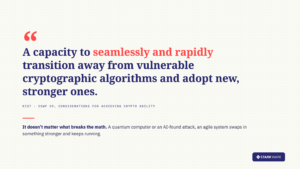
Quantum resistance solves the problems we can measure today. Cryptographic agility is how you handle the ones that come next: a quantum breakthrough, an AI-found attack, or a post-quantum scheme that turns out weaker than expected.
How is Starknet built for cryptographic agility?
StarkWare CEO Eli Ben-Sasson proposed what it takes for a chain to become future-proofed: the right cryptography, crypto agility, and control over its own upgrades. Starknet has the first two today and is exploring the final piece.
Cryptographic agility: account abstraction. On Starknet, every account is a programmable smart contract, through a design called native account abstraction. Each account can switch to a new signature scheme and keep its address and funds, with no fork and no network-wide migration.
OpenZeppelin has already demonstrated an account using Falcon-512, a post-quantum signature scheme, on Starknet mainnet. Falcon is lattice-based, like ML-DSA. If lattices become insecure, the same upgrade path can let an account move again. No Starknet account is locked into a single signature scheme.
The right cryptography: hash-based proofs. Starknet’s proving layer is inherently quantum-resistant, as it is built on hash functions, not elliptic curve assumptions. StarkWare invented STARK proofs in 2018 and since then we have secured over one trillion dollars in cumulative trading volume using STARKs. This layer does not depend on lattices, so if AI erodes them, it does not need replacing.
StarkWare CEO Eli Ben-Sasson compares quantum computers and AI to a tsunami, with each type of cryptography standing on higher or lower ground:
Hash-based cryptography is the tallest mountain, 1,000 miles away from the ocean… It could be that all other cryptography is broken, and you still have hash functions. For the quantum tsunami, pick a really high mountain. For the AI tsunami, pick nothing but the highest mountain.
Control over its own upgrades: becoming an L1. Today, Starknet depends on Ethereum for parts of its security, so it cannot fully secure itself on its own timeline. We are actively researching transitioning Starknet to an L1, so it can upgrade its own cryptography end to end and become the first fully quantum-resistant network, with 2027 as our target.
The aim is to reduce inherited L1 exposure by bringing more critical security assumptions under Starknet-controlled infrastructure.

Future-proof means cryptographic agility
If you want a future-proof blockchain, you need cryptographic agility. Nobody knows which algorithm survives the next five years of AI math or quantum hardware. Starknet is built so it doesn’t have to know: hash-based proofs, accounts that can change their own cryptography, and a path toward controlling its own upgrades.
Quantum resistance is how you survive now. Cryptographic agility is how you stay surviving.
The next steps for us, from hash migrations to post-quantum consensus signing, are set out in our quantum hub.